World Hearing Day 2026
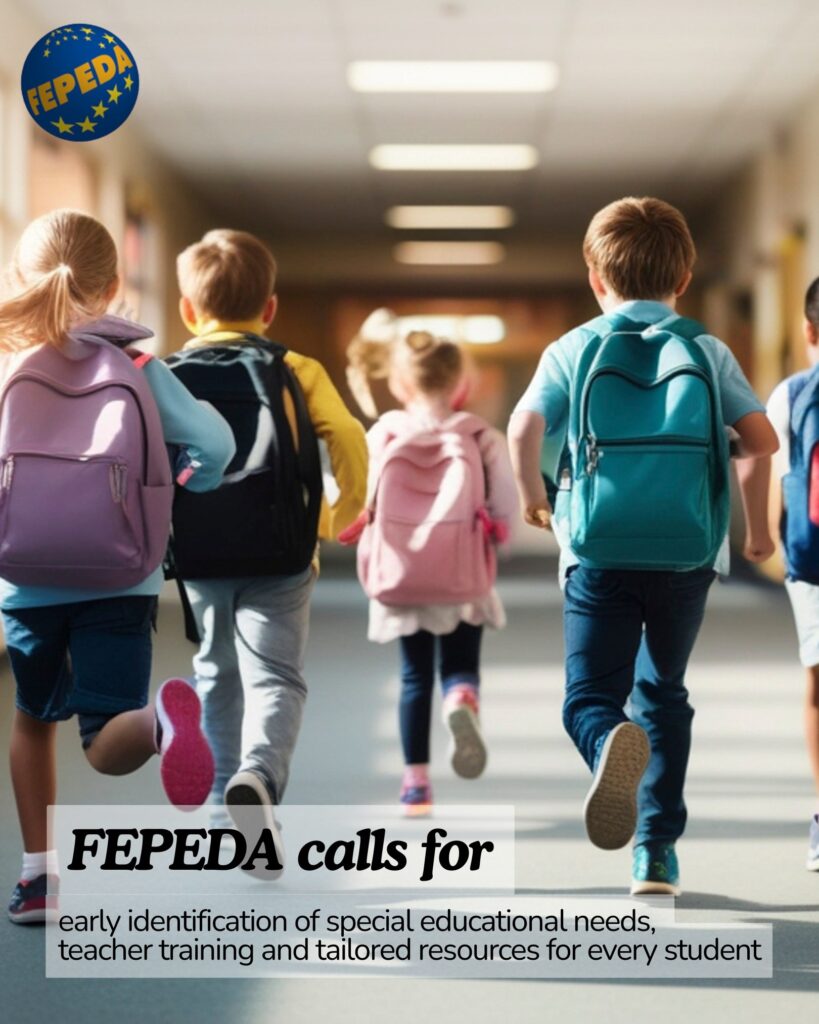
On the occasion of World Hearing Day, and under this year’s slogan promoted by the World Health Organization, “From communities to classrooms”, the FEPEDA (European Federation of Parents of Hearing Impaired Childrent) calls on European education authorities to strengthen the early identification of special educational needs among pupils with a hearing disability and to ensure appropriate support at every stage of schooling.
Significant progress has been made in Europe in early detection of hearing loss. According to FEPEDA’s European study (2020–2021), 60% of children were diagnosed through neonatal hearing screening, representing a substantial improvement compared to previous years. However, identifying hearing loss is not sufficient if education systems fail to detect in a timely manner the specific educational support needs that may arise throughout a student school journey.
Currently, 75% of students with hearing disability are enrolled in mainstream schools. Nevertheless, only 46% of families believe that their children receive education on an equal footing with their hearing peers. This figure demonstrates that inclusion cannot be measured solely by school placement, but by the quality of learning, participation and future opportunities.
“Early identification must not be limited to medical diagnosis. It is equally essential to identify, as early as possible, each pupil’s specific educational needs and to activate the necessary resources in every case to guarantee equal participation and learning,” the Federation states.
FEPEDA underlines that both initial and continuous teacher training are essential. Recognising warning signs, understanding the impact of hearing loss on learning and applying accessible teaching strategies require specific preparation and ongoing professional development.
Moreover, genuine inclusion requires the effective provision of resources tailored to each student: hearing assistive devices, sign language interpreters for those students who use sign language, specialised professionals, methodological adaptations and reasonable accommodations. FEPEDA’s study shows that 45% of families are dissatisfied with the level of financial support received, reflecting inequalities in access to these resources across European countries.
On this World Hearing Day, FEPEDA urges European institutions and Member States to:
➢ Establish systematic mechanisms for the early identification of special educational needs throughout the entire school career.
➢ Ensure specialised and continuous training for teachers.
➢ Provide stable and sufficient funding for tailored resources and support for every student.
➢ Reduce territorial inequalities in access to educational support.
FEPEDA reaffirms its commitment to working alongside families, the education community and public institutions so that, from communities to classrooms, no child or young person with hearing disability is left behind and each can fully develop their potential.
Die Empowerment-Trainings OHRENSTARK, die von der Frankfurter Stiftung für Gehörlose und Schwerhörige veranstaltet werden, stärken Schülerinnen und Schüler mit einer Hörbeeinträchtigung. Viele junge Menschen mit Hörgerät, Cochlea Implantat, AVWS oder einseitiger Hörschwäche stehen im Schulalltag vor der Herausforderung, dem Unterricht zu folgen. Dazu müssen sie offen über ihre Hör- und Verstehbedürfnisse sprechen können. Bei den „Empowerment-Trainings Ohrenstark“ erlernen sie Strategien, wie sie selbstbewusst für ihre sozial- und bildungsrelevanten Bedürfnisse eintreten und sich Gehör verschaffen können, ohne sich dabei zu überfordern. Das Angebot richtet sich ab diesem Jahr an alle Schulkinder allgemeiner Schulen von der Grundschule bis zum Abitur.
Wer bei Ohrenstark mitmacht, stärkt sein Selbstbewusstsein und bekommt nützliche Tipps für den Umgang mit täglichen Hör-Barrieren.
Für bessere Chancen in Schule und Freizeit gibt es in Kleingruppen neben wertvollen Infos viele spielerische Übungen von coolen Empowerment-Trainerinnen und -Trainern, die selbst eine Schulzeit mit Hörbehinderung hinter sich haben. Die Treffen fördern mit viel Spaß und Action unter Gleichgesinnten die Persönlichkeits- und Identitätsentwicklung.
Auch wenn man beim ersten Ohrenstark Treffen meist nicht so genau weiß, was da auf einen zukommt, es lohnt sich!
Das haben bis jetzt noch alle gesagt. Deswegen, nicht zögern, es gibt nur eine begrenzte Anzahl Plätze.
Weitere Infos und Anmeldung unter: https://www.glsh-stiftung.de/unser-angebot/bildung-kultur-empowerment/ohrenstark/